Bruchim Summer Update 2025
Hello Friends of Bruchim, We’re delighted to bring you an update on the exciting things we’ve been doing this summer, and how you can get involved!
August 14, 2024 — In 2022, Brendon Marotta, who once explored the circumcision controversy in an independent film, self-published a book and wrote blog posts expressing his opinions about Jewish people related to circumcision. Both Jewish and non-Jewish individuals publicly criticized his writings. Subsequently, Marotta filed a lawsuit claiming he had been defamed, suing only…
April 5, 2024 — Bruchim, the nonprofit that is shattering taboos around Jewish circumcision, has launched a podcast to explore the practice through a critical lens. Founded in 2021, Bruchim supports non-circumcising Jews while encouraging synagogues and other Jewish institutions to accept the choice not to circumcise. This 10-episode debut season of The Bruchim Podcast tells…
July 28, 2022 — New York Times bestselling novelist Gary Shteyngart (Our Country Friends, 2021) and Bruchim’s Max Buckler appear together as guests on Evolve, the podcast of Judaism’s Reconstructionist Movement. Shteyngart and Buckler’s friendship began on social media after Shteyngart published a New Yorker essay describing his own botched bris. Buckler, a circumcision critic and…
March 2, 2022 — While there is no single definition of hate speech, the term generally describes public discourse (spoken or in print) that attempts to vilify, scapegoat, humiliate, or incite hatred against people or groups based on race, religion, ethnicity, country of origin, biological sex, sexual orientation, gender identity, and so on. Freedom…
February 1, 2022, BY Max Buckler — As a founding member of Bruchim, the new Jewish nonprofit advocating for Jews who hold critical views of brit milah, I seek to build bridges between those who continue to practice the traditional ritual and the growing number of Jews who have come to believe, as I do,…
January 30, 2022, BY Rabbi Barbara Thiede — No, circumcision does not make a Jew. No, what ancient peoples called circumcision wouldn’t count as one for us. And, no, we do not have proof that circumcision was unquestioned or even highly valued by our ancestors. History and mythology have a complicated relationship. The latter is not…
Please join Bruchim for a special live event — open to all — with Bruchim’s own Biblical Scholar In Residence, Rabbi Tzemah Yoreh, Ph.D. Your RSVP to info@bruchim.online is appreciated but not necessary. Follow this link on Thursday February 3rd at 8:15 p.m. EST to join the program, which will take place on Zoom and…
January 31, 2022 — This piece is the FIRST EVER Judaism Unbound “Gemara” (commentary). It is a reflection, written by Eli Hurwitz, on a Judaism Unbound podcast episode (Episode 303: “Bris” Means “Covenant,” Not Circumcision). It explores the idea of kavanah (spiritual intent), as applied to difficult Jewish conversations. By Eli Hurwitz, New Voices/Judaism Unbound…
December 24, 2021 — Dan and Lex close out Judaism Unbound’s 4-episode mini-series on Jewish circumcision. They explore, in particular, the treatment by Jewish institutions of families who have opted not to circumcise their children, and of those children themselves. The need for Bruchim’s advocacy on behalf of non-circumcising Jewish families is highlighted, along with…
December 22, 2021 — Bruchim’s Max DuBoff shares a d’var Torah for this week’s parasha, Sh’mot. The passage discussed contains the following enigmatic and confusing episode: And it came to pass by the way in the inn that the Lord met him and sought to kill him. Then Zippora took a sharp stone and cut…
December 10, 2021 — In this text study, Eliyahu Ungar-Sargon walks us through three texts from the heart of the Rabbinic legal tradition that all deal with the matter of intact (uncircumcised) Jewish boys and men. He demonstrates that contrary to common belief, there is plenty of room within the Jewish legal tradition to argue…
December 10, 2021 — Max Buckler, Director of Strategic Initiatives for Bruchim, and Charlene Thrope, a member of its extended team, join Judaism Unbound’s co-hosts, Dan Libenson and Lex Rofeberg, for an eye-opening conversation that explores tensions surrounding Jewish circumcision and emerging alternatives as the primary way to welcome amab (assigned-male-at-birth) babies into the Jewish…
December 3, 2021 — The founding members of Bruchim’s executive board join Dan Libenson and Lex Rofeberg for a conversation on the Judaism Unbound podcast about why their organization exists, how opposition to circumcision can come from a deeply Jewish place, and what it might look like for Jewish communities to explicitly welcome people into…
December 1, 2021 — Five representatives of Bruchim will appear this week and next during two episodes of the podcast Judaism Unbound.
Judaism Unbound, a project of the Institute for the Next Jewish Future, is a project that catalyzes and supports grassroots efforts by “disaffected but hopeful” American Jews to re-imagine and re-design Jewish life in America for the 21st Century.
November 11, 2021 — Eli Ungar-Sargon represents Bruchim on this weekly podcast focusing on Jewish news with a Canadian angle. Show hosts are Avi Finegold, Ilana Zackon and David Sklar. The Bruchim segment “Circumspect About Circumcision” begins at 21:23. Click “Read More” for the link.
October 16, 2021 — Lisa Braver Moss and Eliyahu Ungar-Sargon appeared on Zev Brenner’s radio talkshow, where they had an opportunity to explain Bruchim’s mission to a largely Orthodox audience, fielding questions from people calling in from New York and New Jersey.
October 11, 2021 — ILTV Israel News ran a segment on Bruchim, with analysis provided by Rabbi Andrew Sacks, Director of the Rabbinical Assembly of the Conservative movement in Israel. Sacks made some very important points. He said there is no question that Jewish males who have not been circumcised are fully Jewish and, further,…
October 10, 2021 — Last week news outlets reported on Bruchim’s efforts to seek greater inclusion for non-circumcising Jewish families in Jewish spaces of all kinds, including synagogues.
Leaders from multiple Jewish denominations weighed in, making supportive, inclusionary statements that will shape the landscape going forward for those wanting to be involved in Jewish life and who, for whatever reason, opt not to participate in the circumcision tradition.
October 7, 2021 — It’s the new Jewish year 5782, and a new nonprofit, Bruchim, is seeking to disrupt thousands of years of status-quo. The organization is encouraging Jewish groups of all kinds to openly welcome and include those who feel differently about the ancient rite of circumcision.
“There is a growing number of engaged Jewish people who aren’t circumcising,” says Max Buckler, Bruchim’s Communications Director. “Many of these families are involved in Jewish life but aren’t sure how their community will react. Will their child receive a warm, spiritually fulfilling welcome?”
What’s New? October 7, 2021 — The Jewish Telegraphic Agency published a feature article profiling Bruchim’s launch. The article was subsequently picked up by other Jewish news outlets, including The Jerusalem Post and the Cleveland Jewish News.
Today brit shalom is more widely known about and practiced than ever before. Still, many Jewish websites and parenting guides omit any information about ceremonial alternatives to brit milah. Bruchim believes that ignoring the existence of non-circumcising Jews does not build authentic, vibrant Jewish communities. Bruchim’s mission is, in part, to effect meaningful change in…
In the early 2000s, Mark Reiss, M.D. stepped up to the plate with an innovative concept. A retired radiologist and an active member of his Conservative congregation, Dr. Reiss felt compelled to help Jewish families seeking circumcision alternatives. He compiled, and has maintained, an online list of brit shalom officiants throughout the United States, Europe,…
One notable exception to the difficulties experienced by non-circumcising Jews was for those members of the non-theistic branch of Judaism known as Humanistic Judaism. Founded in the early 1960s by Rabbi Sherwin Wine, Humanistic Judaism has always rejected the necessity of circumcision. Rabbi Wine did not use the term brit shalom, but rather advocated naming…
Although some Jewish people throughout history have chosen not to circumcise, the idea of a replacement ceremony for the traditional bris is relatively new. One of the first known rabbi-led brit shalom ceremonies took place in the mid-1980s and was officiated by Rabbi Nathan Segal (1949-2019). In addition to being a non-circumcising Jew, Rabbi Nathan…
Jewish services and celebrations are usually followed by a festive meal. New parents might be too tired to want to cook, so ordering in or having everyone bring a dish to share are popular options. It’s a matter of personal choice and budget whether your brit shalom is a fully catered event or a simple…
There is no standard formula for a brit shalom, and parents and/or clergy should choose blessings and readings that are meaningful both for the moment and for the specific family. Planning the brit shalom is a creative act. Liturgy might closely follow that of brit milah, with the act of circumcision being replaced by something…
If your family is having a brit shalom, you’ll probably want to assign roles (for example, kvatter and sandek, who are honorees) and have a few things on hand, including chosen prayers, kosher wine, a kiddush cup, a challah, a ceremonial chair, a pillow for the baby to rest on, etc. For more information about…
When it comes to having a brit shalom, there are lots of choices. Rabbi-led in a synagogue is an option, but these ceremonies can also take place at home, or even outdoors. A family’s prior involvement in congregational life, the time of year/weather, and what feels most comfortable for parents and baby are often deciding…
Babies assigned female at birth are typically given a Hebrew name during the Torah service shortly following their birth. Brit milah is a male-only ceremony, and brit shalom was originally conceived to be a male-only alternative. However, modern notions about gender and equality are changing the way many of us look at Jewish ritual —…
Naming ceremonies for hospital-circumcised babies enable parents to have a Jewish birth ceremony when they feel a hospital circumcision is more convenient or otherwise superior to brit milah, or when brit milah feels foreign due to their secular or interfaith backgrounds. Parents of babies who are intact may also choose to have a naming. Some…
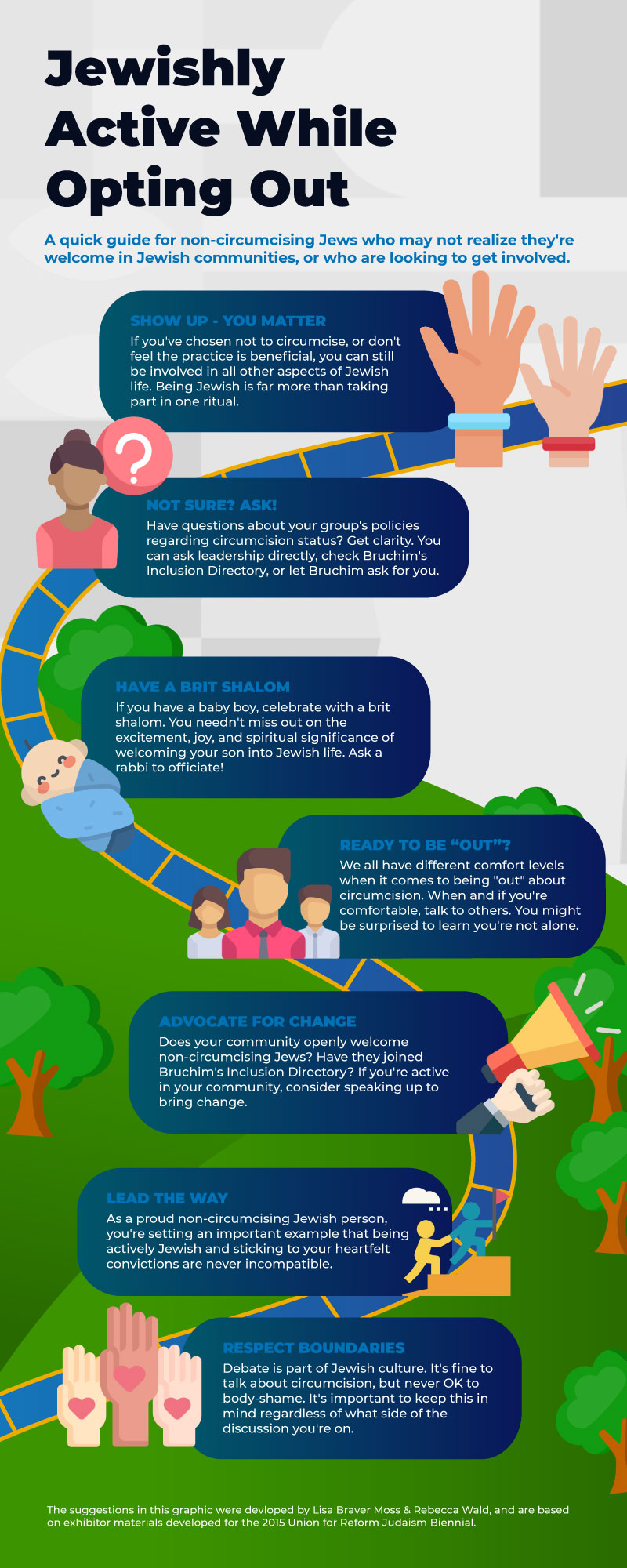
In one sense, a brit shalom is nothing more than a covenantal naming and welcoming ceremony for a baby who isn’t being circumcised. In another sense, it’s the parents’ declaration that although they’ve opted out of circumcision, they are choosing to raise a Jewish child — and are proud to be both Jewish and non-circumcising…
Most Jews regard circumcision as a given. For the devout, it’s the fulfilment of a divine commandment, an act of faith. For many others, regardless of their beliefs, circumcision remains a powerful statement among the Jewish people. Jewish thinkers throughout the ages have reflected on the benefits. Moses Maimondes felt it kept sexual desire in…
Embracing Diversity Jewish institutions have made great strides to welcome and include diverse participants. This is not only the right thing to do; it makes for inviting and vibrant communities to which people can bring their authentic selves. We typically don’t think of ritual diversity in the same way that we think of other kinds…
Understanding the Decision Not to Circumcise Most Jews regard circumcision as a given. For the devout, it’s the fulfilment of a divine commandment, an act of faith. For many others, regardless of their beliefs, circumcision remains a powerful statement among the Jewish people. Jewish thinkers throughout the ages have reflected on the benefits. Moses Maimonides…
What Is Brit Shalom? When a new Jewish baby comes into the family, it’s prime time to gather and celebrate. Traditionally, on the eighth day of life, babies assigned male at birth have a brit milah where they’re circumcised and given their Hebrew name. But what about families opting out of circumcision? Brit shalom encompasses…